

Kinzaad is a UAE-based business setup and corporate services firm offering solutions such as mainland and free zone company formation, visa services, and corporate compliance support. I led a six-month Meta Ads engagement focused exclusively on generating qualified inbound enquiries from business owners and investors within the UAE.
The objective was to build a scalable lead generation system capable of handling high-intent commercial demand while maintaining strict control over cost per lead. Business setup enquiries represent a high-value, high-consideration conversion event. Prospects typically compare multiple providers, evaluate pricing structures, and assess credibility before submitting an enquiry.
Given this behavior, performance depended less on reach alone and more on intent alignment, message clarity, and disciplined optimization. Meta was selected as the sole acquisition channel due to its ability to scale lead volume while allowing granular control over audiences, creatives, and delivery.
Meta lead forms were used as the primary conversion mechanism to reduce friction, improve mobile completion rates, and stabilize volume across demand cycles.
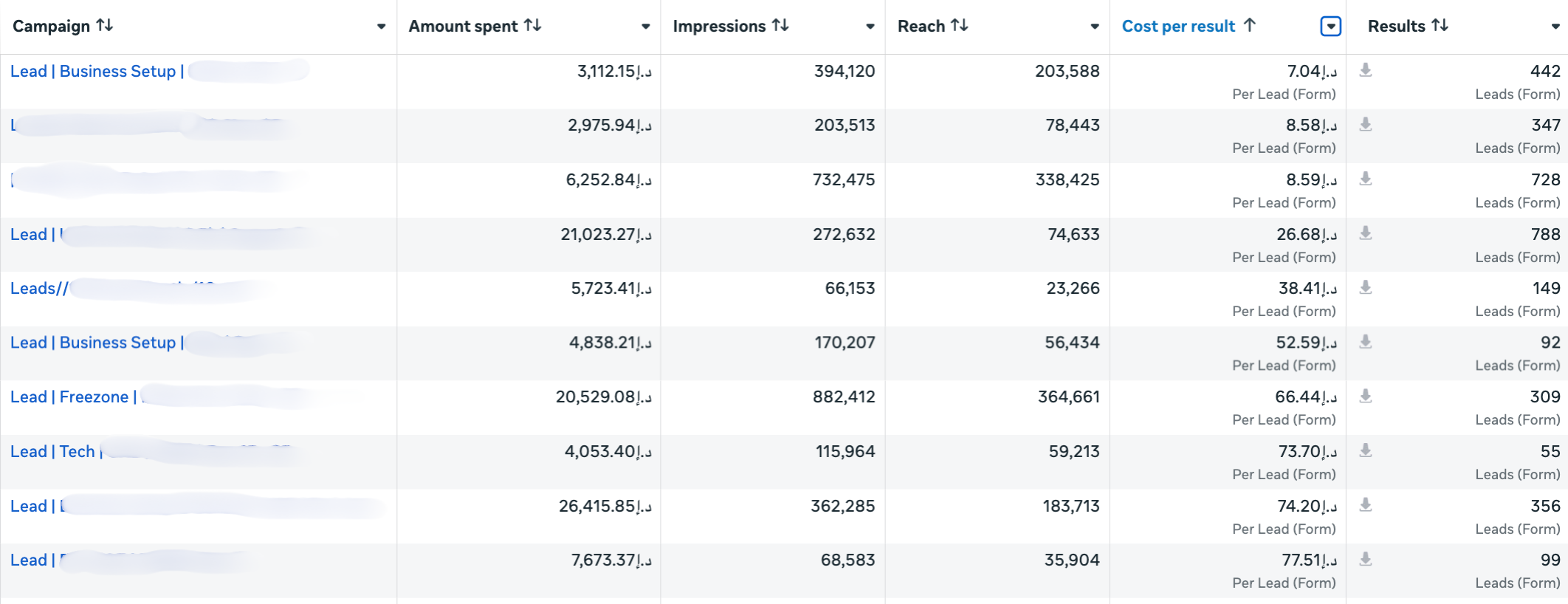
These results reflect aggregated performance across all Meta lead campaigns during the six-month engagement period.
Before scaling spend, I conducted a detailed review of both the UAE business setup market and the existing Meta Ads account structure.
Business setup is not an impulse decision. Messaging accuracy and expectation-setting play a critical role in lead quality and downstream conversion.
The account did not require new platforms or aggressive experimentation. It required structure, prioritization, and CPL discipline.
The category is saturated with advertisers targeting similar audiences. Broad messaging tends to inflate lead volume while reducing intent quality.
Different services (free zone, mainland, visas, bundled offers) exhibited materially different cost behaviors. Without segmentation, inefficient campaigns risked absorbing excessive spend.
As budgets increased, maintaining CPL stability became the primary constraint. Volume without efficiency would have undermined commercial viability.
Historical performance demonstrated that Meta could deliver large-scale lead volume when campaigns were aligned to service-level intent and pricing expectations.
The opportunity was to isolate high-performing service clusters, reduce waste from low-intent traffic, and apply a cost-controlled scaling framework across the account.
Campaigns were structured by service category rather than broad business setup themes. Each major offering operated as an independent lead generation campaign, allowing for precise budget control and clear performance visibility.
This structure made it immediately clear which services justified additional spend and which required intervention.
Meta lead forms were used instead of traffic-based conversions to:
Forms were intentionally designed to balance simplicity with qualification, avoiding unnecessary fields while filtering casual interest.
Budgets were allocated dynamically based on:
Campaigns with rising CPLs were capped or deprioritized until efficiency improved.
Creative focused on the specific service being offered rather than generic business setup claims. Ads emphasized clarity around use cases, eligibility, and next steps.
This approach pre-qualified users before form submission and reduced low-intent enquiries.
Messaging avoided aggressive pricing hooks. Instead, copy focused on:
This improved lead relevance and reduced mismatch between expectation and offer.
A key focus of the engagement was systematic CPL reduction over time.
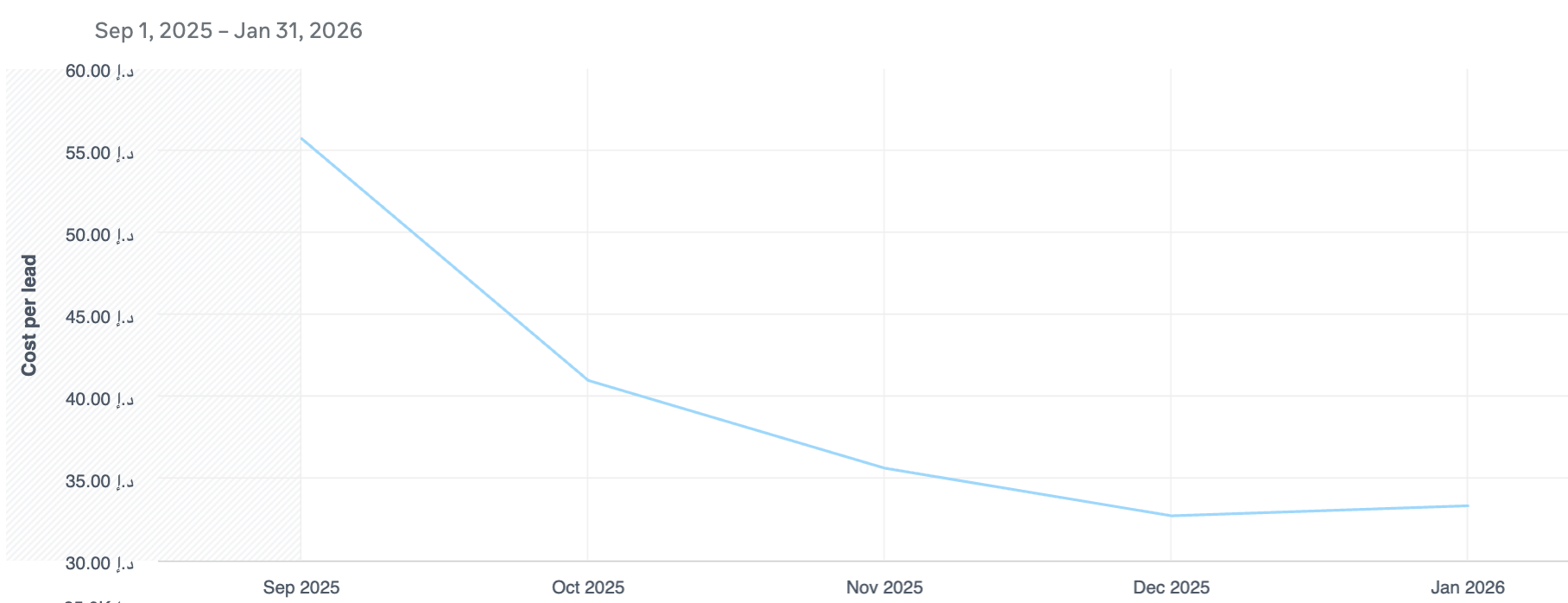
Over the six-month period, average CPL declined steadily as inefficiencies were identified and removed. Early campaigns operated at higher CPLs, which were progressively reduced through structural and creative optimization.
Observed CPL trend:
This downward trend reflects deliberate optimization rather than algorithmic fluctuation.
Key actions taken to reduce and stabilize CPL included:
These changes allowed volume to scale without reintroducing inefficiency.

Across multiple service-led campaigns, Meta delivered sustained lead volume at controlled acquisition costs in a highly competitive category.
This approach worked because it prioritized structure over experimentation and cost discipline over raw volume.
By treating each service as an independent acquisition unit and scaling only where efficiency was proven, the strategy avoided the common failure mode of volume-driven CPL inflation.
Over six months, Meta Ads generated 4,868 inbound enquiries for Kinzaad while maintaining controlled acquisition costs in a competitive UAE business setup market.
The results demonstrate that scalable lead generation for corporate services does not require complex funnels or aggressive promotions. It requires disciplined campaign architecture, service-aligned intent targeting, and continuous CPL optimization.