

Salama Radiator is a B2B automotive manufacturing company specializing in radiators and industrial cooling solutions for automotive, commercial vehicle, and industrial applications. The business serves automotive distributors, industrial buyers, fleet operators, workshops, and procurement departments that prioritize product reliability, specification accuracy, and supplier credibility.
The client’s commercial growth depends on capturing high-intent inbound demand rather than broad awareness. Buyers typically enter the funnel with a defined need—replacement radiators, cooling systems, or manufacturing-grade components—and evaluate suppliers based on trust, responsiveness, and perceived production capability.
For this engagement, Salama Radiator’s priority market was Saudi Arabia, a region with sustained demand driven by transportation, construction, logistics, and industrial infrastructure.


A pre-campaign audit focused on understanding demand structure, buyer intent, and performance ceilings.
Search demand clustered around:
This was commercial-intent demand, not educational or exploratory traffic.
Saudi Arabia showed clear bifurcation:
Search impression share sat between 14–16%, indicating substantial untapped demand but limited auction presence.
|
Metric
|
Value
|
|---|---|
Low impression share meant that even well-performing ads were only visible for a fraction of eligible searches.
Without strict keyword and messaging alignment, spend risked going toward:
The challenge was not generating clicks, but ensuring that increased spend did not inflate:
Despite constraints, early signals revealed strong potential:
The account was structured into two Search campaigns, segmented by language.
|
Campaign
|
Language
|
Purpose
|
|---|---|---|
This allowed:
Maximize Clicks was used deliberately—not as a set-and-forget tactic.
Campaign-level CPC efficiency:
|
Campaign
|
Avg. CPC
|
|---|---|
Lower CPCs in Arabic enabled broader demand coverage without sacrificing conversion quality.
Ad copy was engineered for industrial and procurement decision-makers, prioritizing:
No generic branding language. No promotional fluff.
|
Campaign
|
CTR
|
|---|---|
The English campaign’s higher CTR reflected strong technical intent, despite lower volume.
Cost per conversion was treated as a primary performance constraint, not a vanity metric.
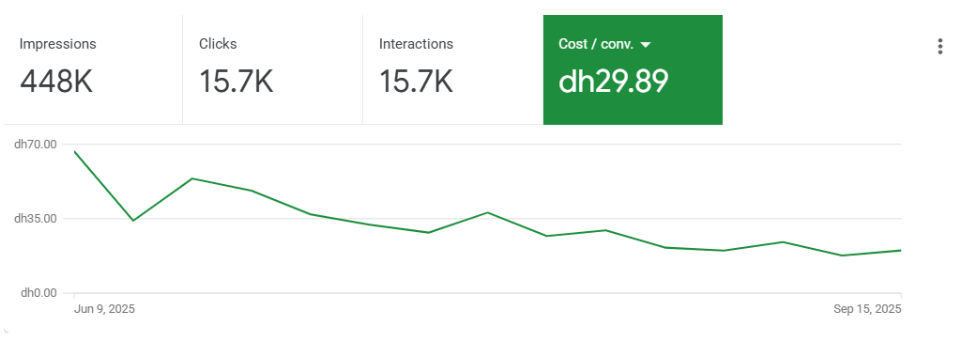
Over time, the cost-per-conversion trend moved downward and stabilized, as reflected in the declining CPA graph from June to September.
Scaling decisions were made only after performance consistency was established, ensuring long-term sustainability.

This campaign succeeded because it aligned with how B2B automotive buyers actually behave:
The strategy focused on harvesting existing demand efficiently, not forcing artificial scale.
Over six months, Salama Radiator achieved:
This case study demonstrates how search-led demand capture, when structured correctly, can serve as a reliable growth engine for automotive and industrial manufacturers targeting procurement-driven markets like Saudi Arabia.