
Building a Scalable Ecommerce Revenue Engine Using Meta & Google Ads

A Performance Marketing Case Study

Purchases Generated
0 +
Avg ROAS
0 x
RS Ad Budget Managed
0 M

Client Overview

Shopelegancia is a women-focused fashion ecommerce brand operating across India, Pakistan, and select Gulf markets. The brand sits in a highly competitive category where purchase decisions are driven by a combination of visual appeal, price sensitivity, trust, delivery reliability, and seasonal demand.

At the start of this engagement, Shopelegancia had an established product-market fit and an active customer base but lacked a structured performance framework across paid channels. Campaigns were running, but budget allocation, optimization depth, and conversion signal clarity were inconsistent.

The mandate was clear: scale purchase revenue efficiently while maintaining profitability across Meta Ads and Google Ads — without inflating CAC as spend increased.

Initial Analysis

A full-funnel and account-level audit was conducted across both platforms before any scaling decisions were made.

Observed Data Signals

  • High purchase volume already existed, indicating strong underlying demand.
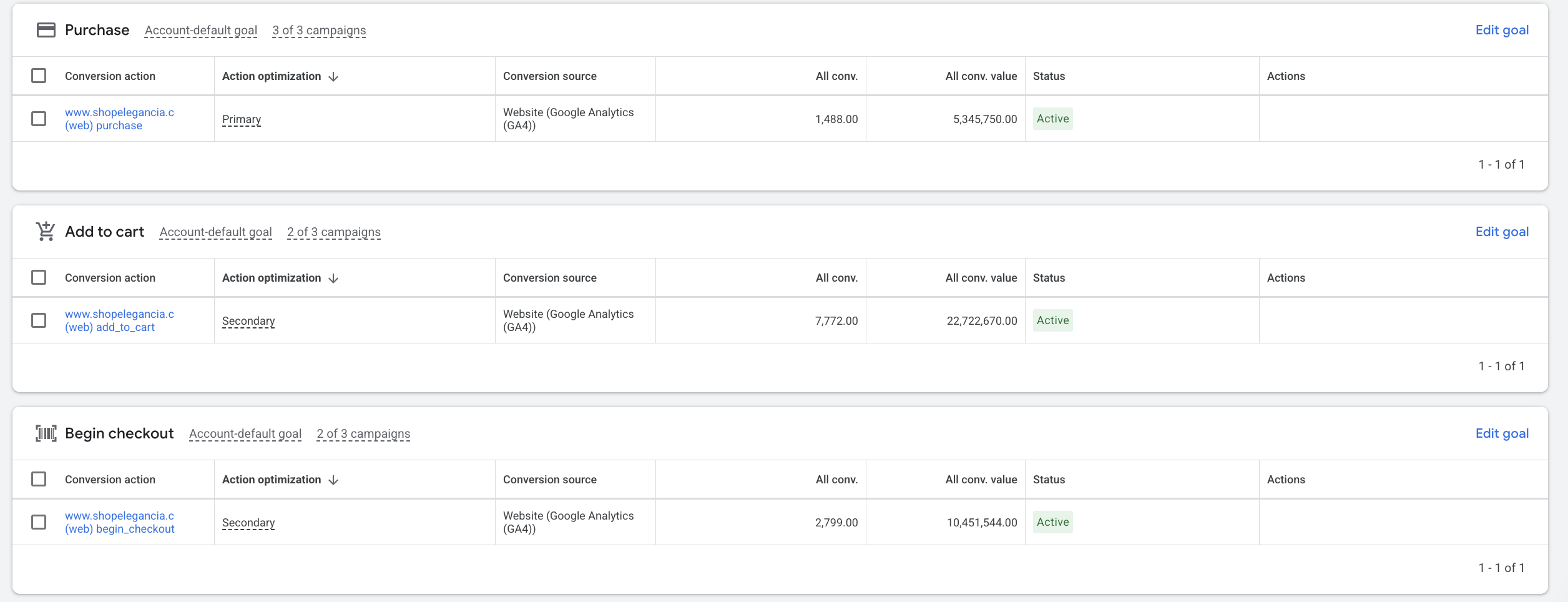
  • Add-to-cart and begin-checkout volumes were significantly higher than purchases, signaling drop-off friction but also remarketing opportunity.
  • Impression share on Google was consistently below 10%, indicating untapped scale potential.
  • On Meta, several long-running Advantage+ Shopping and catalog campaigns were delivering steady purchase volume but with mixed cost efficiency.

Tracking & Attribution

  • GA4-based purchase events were active and mapped correctly to Google Ads.
  • Meta purchase events were optimized at campaign level.
  • Attribution windows were platform-default and kept unchanged to avoid data pollution during scaling.

The data confirmed this was not a demand-generation problem — it was a structured scaling and efficiency problem.

Core Challenges

1. Volatile Cost Per Purchase Across Campaigns

While some campaigns delivered purchases under Rs600, others crossed Rs900+, creating inconsistency in blended CAC.

2. Creative Fatigue in Core Audiences

Repetitive catalog formats and static creatives had begun to show diminishing returns in high-frequency segments.

3. Uneven Budget Allocation

High-performing campaigns were underfunded while lower-efficiency campaigns continued consuming spend.

4. Regional Performance Variance

India delivered scale, while Pakistan and Gulf markets required tighter efficiency controls due to smaller audience pools.

Opportunity Mapping

Based on the audit, four clear opportunities emerged:

  • Aggressive scaling on campaigns with stable cost-per-result below account average.
  • Expansion of mid-funnel and bottom-funnel remarketing using add-to-cart and checkout audiences.
  • Platform-native optimization (Advantage+ Shopping on Meta and value-based bidding on Google).
  • Creative systemization focused on catalog variation rather than net-new production volume.

Objective & KPI Framework

Primary Objective

Drive maximum purchase volume and conversion value while maintaining a sustainable blended cost per purchase.

Primary KPIs

  • Purchases (Website)
  • Conversion Value
  • Cost Per Purchase
  • ROAS (Platform-Reported)

Secondary KPIs

  • Click Volume and CPC stability
  • Conversion rate stability during scale
  • Impression share growth (Google)

Strategy Breakdown (Platform-Specific)

Meta Ads Strategy

Meta was positioned as the primary volume driver.

Campaign Architecture

  • Advantage+ Shopping campaigns formed the backbone of scale.
  • High-volume catalog campaigns were segmented by creative theme rather than audience.
  • Prospecting and retargeting were consolidated to allow algorithmic learning at scale.

Bidding & Budgeting

  • Majority of campaigns ran on Highest Volume or Highest Value bidding.
  • Budgets were increased incrementally only after 3–5 days of cost stability.
  • Underperforming campaigns were not paused aggressively; budgets were gradually reduced to preserve learning.

Audience Approach

  • Broad and algorithm-driven targeting was prioritized.
  • Manual audience stacking was limited to warm audiences (view content, add to cart, checkout).
  • Lookalike expansion was avoided once scale plateaued, as broad consistently outperformed.

Google Ads Strategy

Google was treated as an intent-capture and efficiency channel.

Campaign Structure

  • Shopping and Performance Max campaigns focused exclusively on purchase optimization.
  • Conversion value bidding was used to prioritize high-value purchasers.

Impression Share Strategy

  • Sub-10% impression share highlighted lost revenue opportunity.
  • Budgets were expanded cautiously to avoid CPC inflation.
  • Search term monitoring ensured brand queries remained protected.

Creative & Messaging Strategy

Creative was not treated as decoration — it was treated as a conversion lever.

Core Creative Principles

  • Product-first visuals with minimal overlay text.
  • Price anchoring for value-sensitive markets.
  • Cultural relevance in styling for India, Pakistan, and Gulf buyers.
  • Emphasis on ease: delivery, returns, and payment reassurance.

Format Mix

  • Dynamic product catalogs for scale.
  • Static best-seller creatives for efficiency.
  • Seasonal refreshes layered on top without disrupting winning structures.

Creative refresh cycles were aligned with performance decay, not calendar schedules.

Optimization & Scaling Process

Optimization followed a disciplined, repeatable framework:

  1. Stability First
    No scale actions were taken unless cost per purchase held within a defined tolerance range.
  2. Vertical Scaling Over Horizontal Sprawl
    Budgets were increased on winning campaigns rather than launching excessive new ones.
  3. Lag Awareness
    Performance was evaluated on rolling 3–7 day windows to respect conversion lag.
  4. Creative Rotation Without Resetting Learning
    New creatives were introduced without duplicating campaigns whenever possible.

Results & Performance Metrics

Google Ads Highlights ( 3-Month Period)

  • Total Conversion Value: Rs5.33M
  • Total Spend: Rs867K
  • Purchases: 1,488
  • Cost Per Conversion: Rs584
  • ROAS: 614.70%
Google ads metrics
Google ads Metrics

Add to cart > Begin Checkout > Purchase

Add to cart > initiate checkout > purchase
  • Strong conversion rate for a high-consideration product
  • Controlled cost per sign-up across the full period
  • High CTR indicating strong ad-to-intent alignment
  • Achieved results with <10% impression share, leaving clear room for future scale

Meta Ads Highlights ( 8-Month Period)

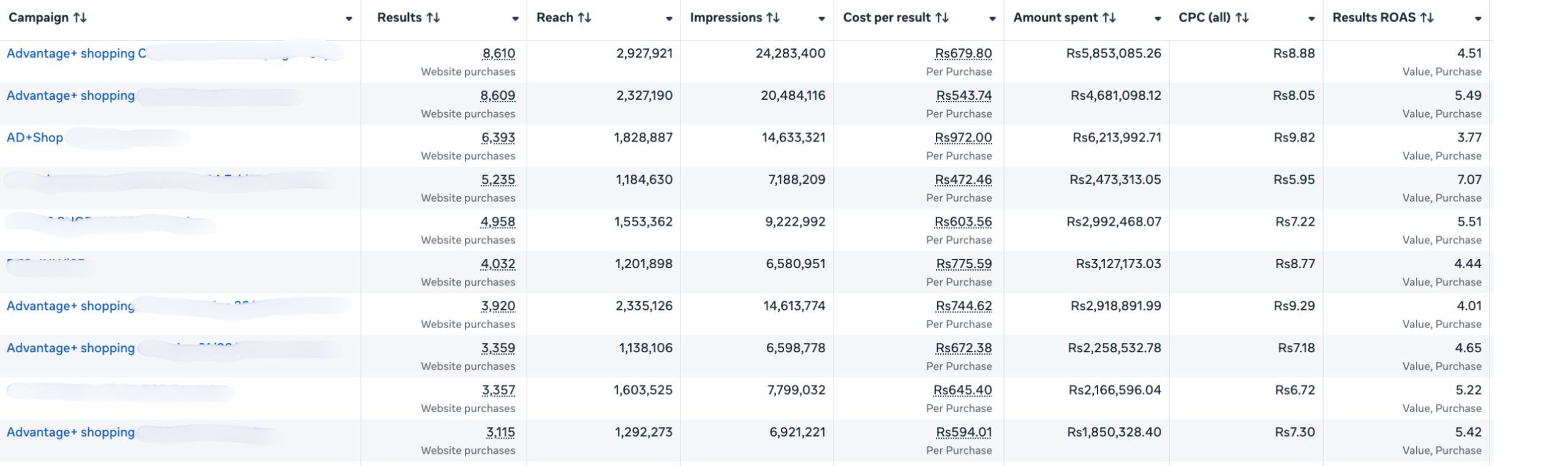
  • Total Purchases (Account-Level): 70,987
  • Total Spend: Rs77.35M
  • Cost Per Purchase Range: Rs472 – Rs972
Eccomerce meta results

Meta delivered the majority of volume, while Google delivered outsized efficiency.

Google vs Meta Platform Comparison

Best Performing Platform

Meta Ads was the primary growth engine, responsible for the majority of purchase volume and revenue.

Google Ads delivered superior efficiency, with a 614.70% ROAS and strong cost control, making it the most profitable channel on a marginal basis.

The combination — not competition — between platforms unlocked overall account growth.

Key Insights & Learnings

  1. Broad targeting outperformed complex audience layering at scale.
  2. Catalog-based systems consistently beat isolated product ads over long periods.
  3. Controlled budget increases preserved algorithm stability.
  4. Creative variation mattered more than constant reinvention.
  5. Google impression share below 10% signals future upside, not failure.

Why This Worked

  • The strategy respected platform mechanics instead of fighting them.
  • Scaling decisions were data-gated, not emotional.
  • Creative, media buying, and analytics were aligned to one goal: purchases.
  • Both platforms were used for what they do best.

Conclusion & Positioning

This case study demonstrates how disciplined execution, platform-native strategy, and data-driven scaling can drive sustained ecommerce growth — even in highly competitive fashion markets.

Shopelegancia’s results were not driven by hacks or short-term tactics, but by building a performance system capable of compounding over time.

For brands seeking predictable, scalable revenue across Meta and Google, this engagement reinforces a simple truth: sustainable growth comes from structure, patience, and precision — not guesswork.