

Xperienz Holidays is a UAE-based travel and tourism brand offering international holiday packages across multiple destinations. I led a six-month Meta Ads engagement focused exclusively on generating travel enquiries from high-intent audiences within the UAE.
The objective was not short-term lead volume, but the creation of a repeatable and scalable lead acquisition system that could operate efficiently across multiple destinations while maintaining strict cost control. Travel enquiries represent a high-consideration conversion event, particularly in the UAE, where users actively compare destinations, providers, and itineraries before submitting a form.
Given this behavior, success depended on disciplined campaign structure, destination-specific intent alignment, and cost-led optimization — not experimentation for its own sake.
Meta was selected as the sole acquisition channel due to its ability to scale reach efficiently while capturing users during active travel planning phases. Meta lead forms were used as the primary conversion mechanism to reduce friction and stabilize conversion volume on mobile.
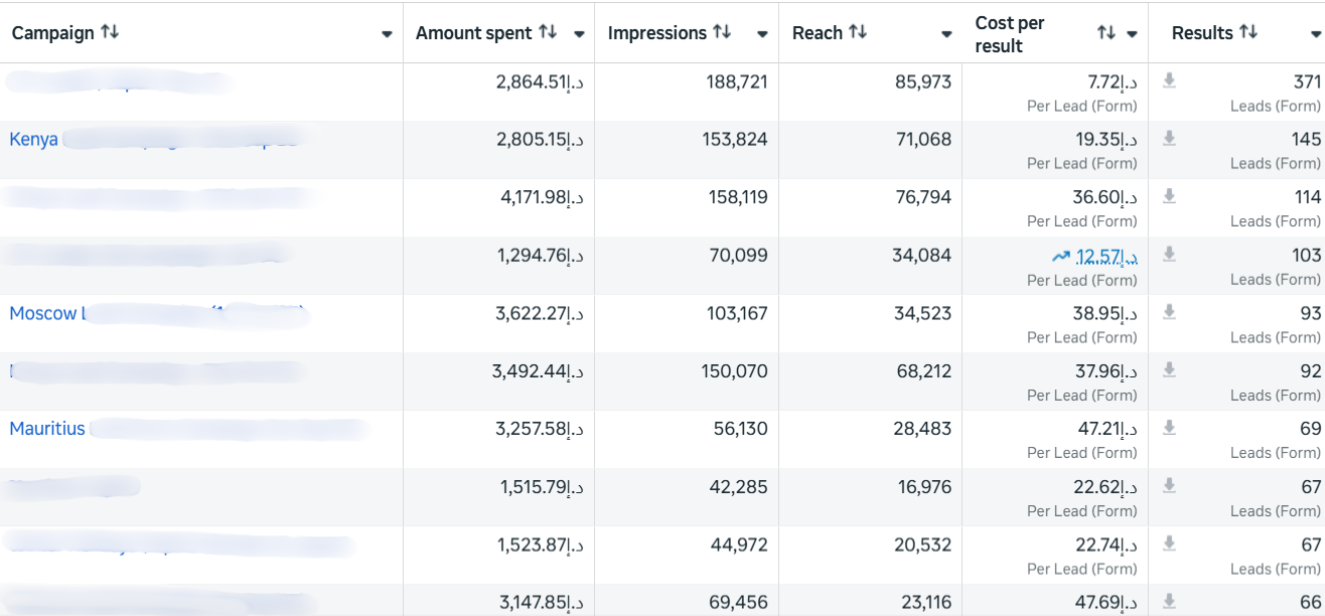
These results reflect aggregated performance across destination-led Meta lead campaigns during the six-month engagement period.
Before scaling spend, I conducted a structured analysis of both the UAE travel market and the existing Meta Ads account environment.
Travel users on Meta are rarely discovering travel for the first time. Most are validating options they are already considering, which places a premium on relevance, clarity, and message alignment.
The account did not require aggressive testing or expansion into additional platforms. It required structural clarity and performance-led prioritization.
The UAE travel market is highly competitive, with multiple advertisers bidding on similar intent signals. Broad or promotional messaging tends to attract low-intent enquiries, inflating volume while degrading lead quality.
Different destinations exhibited different cost behaviors. Without strict segmentation, inefficient campaigns risked consuming budget disproportionally.
Travel demand spiked around winter travel periods, holidays, and destination-specific seasons. Campaigns needed to scale quickly without destabilizing cost efficiency.
Historical performance demonstrated that Meta could consistently generate qualified travel enquiries when campaigns were aligned to destination intent and seasonal demand.
The opportunity was to consolidate spend around high-performing destinations, isolate inefficiencies, and implement a cost-controlled scaling framework that could be repeated across campaigns.
Campaigns were structured by destination, not by generic travel themes. Each destination operated as an independent lead generation campaign, allowing for precise budget control and clean performance analysis.
This structure made it immediately clear:
Meta lead forms were used instead of traffic-based conversions to:
Forms were intentionally kept concise to maximize completion while maintaining enough context to filter low-intent submissions.
Budgets were not distributed evenly. Spend was allocated based on:
Campaigns showing rising costs were capped or deprioritized until efficiency stabilized.
Creative emphasized the destination itself rather than the brand. Ads focused on travel context, experience framing, and seasonal relevance.
This approach pre-qualified users before form submission, improving overall lead quality.
Messaging aligned with:
The strategy avoided aggressive discounting, preserving perceived value while supporting conversion performance.
Copy was direct and functional. Each ad clearly communicated:
No abstract slogans. No unnecessary storytelling.
Scaling decisions were driven by cost-per-lead stability rather than aggregate volume. Budgets were increased incrementally to preserve learning stability and avoid efficiency shocks.
Performance was evaluated at the campaign level rather than blended across the account. This prevented strong campaigns from masking inefficiencies elsewhere.
Spend increases and reductions were applied gradually, allowing performance trends to stabilize before further action.

Across multiple destination-led campaigns, Meta delivered consistent lead volume while maintaining cost efficiency in a competitive market.
This approach worked because it prioritized structure over experimentation and performance data over assumptions.
By treating each destination as an independent acquisition unit and scaling only where efficiency was proven, the strategy avoided common pitfalls associated with volume-first travel advertising.
Over a six-month period, Meta Ads generated 1,110 travel enquiries for Xperienz Holidays while maintaining cost efficiency in a highly competitive UAE travel market.
The outcome demonstrates that scalable travel lead generation does not require complex funnels or aggressive promotions. It requires disciplined campaign architecture, destination-led intent alignment, and cost-controlled scaling.